To keep the lied alive, every year we ask a contemporary composer to write a new lied that shines a contemporary light on the festival theme. On Thursday 21 May, ‘1000 Ways to die in a Climate Disaster’ by Jorian van Nee will have its world premiere. Or are they actually six premieres?
1000 Ways to Die in a Climate Disaster is the mandatory work performed by all participating duos of the Young Artist Platform. This year, we asked Jorian van Nee, who explicitly calls himself both a pianist and a composer, to write that piece. Enthusiastically, he talks about the creation of the work and the urgency he feels to express climate change in music as well: ‘It is painful to see how at this moment, with the wars that are ongoing, there are apparently interests that weigh heavier than our general interest as human beings, namely the earth and nature.’ Writing this lied therefore also worked a bit like a catharsis: ‘It felt quite good to be able to dish out a dig at “the big orange clown”. Art is also intended to expose things that people may remember for the future.’
After being asked to write a new, activist-inspired lied, he began to think in terms of the lyrics, but it wasn’t as though he wrote them first and then set them to music: ‘The “tune”, the theme, came at the start of the writing process, and the lyrics were linked to that. That motif recurs throughout and was the starting point, but it came from both sides: more lyrics brought more music, and more music brought more lyrics. It was a process of brainstorming about both lyrics and music.’ Anyone who thinks that an activist lied is nothing but dark is mistaken, he says: ‘When I started, the idea was that it should be a dark lied, but also a humorous one. It’s a heavy theme about all the ways in which you could die as a result of climate change, but because it’s a list of every possible disaster, it’s also so over the top that it becomes absurd.’
1000 Ways to Die in a Climate Disaster is a conceptual work. When the participating duos in the Young Artist Platform receive the score, they do not see three staves: one for the voice and two for the piano. It is up to them how they are going to perform the work, Jorian explains: ‘It is completely free and nothing is mandatory. Duos are allowed to decide for themselves what they play or sing and in what order. Much is left to the musicians’ choice.‘ Incidentally, that freedom does not mean he is sending them into the wilderness: “That would be too much. I do try to provide direction so that it isn't completely random. It is conceptual in the sense that it is a ”formula’. That does require an extra step of thought from the musicians, because it is not a score that you can just play through. That is also why I tried to keep the musical material relatively simple to balance it out, in favour of the freedom I want to give the musicians. If I had also given the musicians very complex musical material, I would be asking too much.’
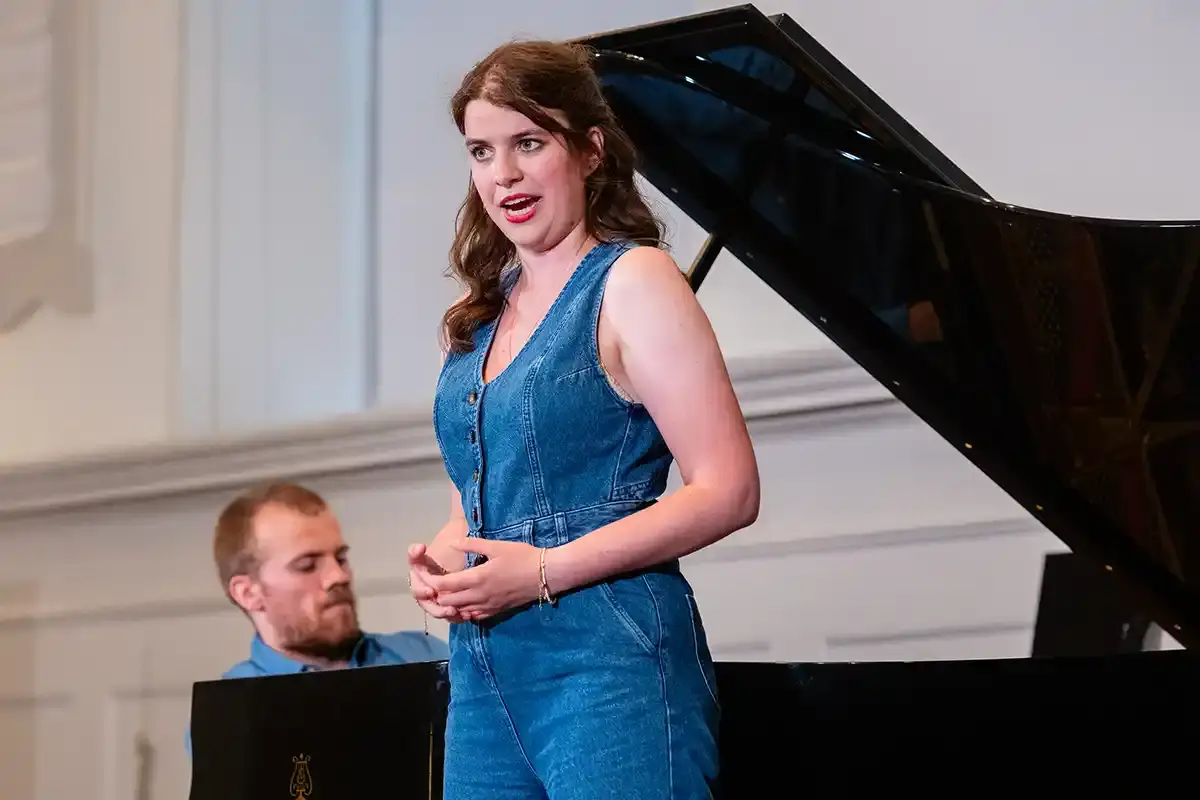
So on Thursday 21 May, not one, but perhaps six world premieres of his work will be heard. What is he hoping for? ‘They are bound to be six different versions anyway, even if all the duos were to make the same choices. Because it isn’t just the structure that is free, but also how the themes themselves are filled in. There is room for improvisation there too, because while I do provide chords and an idea of the piano part, the pianist still has to flesh that out themselves. Or the singer is only given a line with the lyrics and the rhythm and the instruction of which key they have to sing it in. I am genuinely very curious about all those versions.’
As a composer, he hopes that this work will make an impact on classical music by creating more room for improvisation and the musicians‘ own creativity: ’I am a pianist, which is a wonderful profession, but as a composer I feel that there is more scope for personal interpretation in jazz, for example. Over the past century, a division has arisen between being a musician and being a composer. Mozart, Beethoven, Liszt, Rachmaninov... they were all performing composers. They could improvise. Specialisation has emerged whereby you are either a musician or a composer. I don't feel that way myself. I am both a pianist and a composer. I think it can enormously enrich your world as a musician, as well as the audience's, if things become more multidimensional when not everything is predetermined, but there is room for freedom.‘ Calling something a classical work is, as far as he is concerned, outdated: “Anno 2026, classical music can really be anything: conceptual works, reactionary or romantic music... influences blend together and that is precisely what I find so fantastic. You could call 1000 Ways to Die in a Climate Disaster a classical lied, partly because the theme is quite catchy, but I don't place myself in the classical genre. As far as I'm concerned, you're better off forgetting those genres altogether.”
Jorian can also be heard as a pianist on Sunday afternoon, 17 May. In the recital The rising water soprano Noëlle Drost and he tell the story of a single raindrop that forms part of an ever-growing whole, right up to a devastating flood. Images by photographer and documentary maker Kadir van Lohuizen, who acts as narrator, emphasise the urgency of this musical narrative.